
This post contains affiliate links.

This post is part of my Year of Projects: Crochet Master Class series. You can find my first two posts on Tunisian crochet here and here.
I’ve been working on Tunisian crochet a lot in the past few weeks since I’m teaching beginner Tunisian classes at the Finger Lakes Fiber Arts Festival on Saturday and the North Jersey Fiber Arts Festival on September 30. Today, instead of an update on my Tunisian crochet project, I’m so pleased to share an interview with one of the Masters featured in Crochet Master Class , Julia Bryant. Julia is an accomplished needleartist who was born in Southampton and now lives in Toronto.
I love Tunisian crochet and I was struck by the beauty of Julia’s work when I was first exposed to it through Crochet Master Class. Julia can be found on her website, Fibre Fantastics, at the Downtown Knit Collective‘s monthly meetings, or at the Regal Order of Crocheters and Knitters (ROCKS) Guild meetings. All photos in this post are used with Julia’s permission.
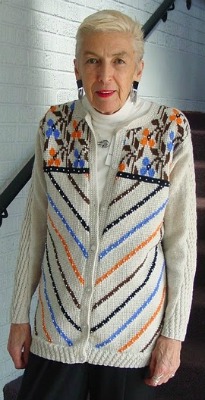
Underground Crafter (UC): How did you first learn to crochet and Tunisian crochet?
Julia: I learnt to knit and crochet as a young child in England. Store bought sweaters were a luxury, so we made our own, often ripping out a garment we had outgrown and re-knitting it. (UC comment: Everything old is new again! Julia was upcycling before anyone even knew the term.) Knitting was my first love, but crochet, cross stitch, weaving and other crafts have always been an important part of my life.
Tunisian crochet took hold about 30 years ago. I found a pattern for a stained glass afghan in Tunisian crochet in a Woman’s Day magazine, and it seemed a great way to use up my stash. Well, it seemed far toonice to put on my bed, so I transformed it into a poncho which I am still wearing to this day.
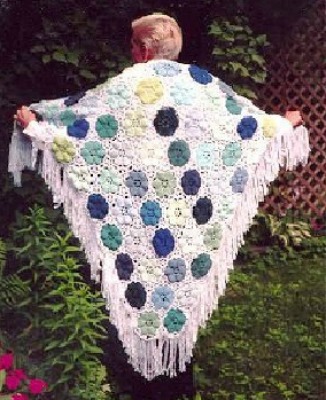
UC: What inspired you to start designing?
Julia: After I discovered the joy of Tunisian crochet and the colour inlay technique I found there were no patterns to be had, so I started designing – there were many mistakes along the way!

UC: You work frequently in Tunisian crochet. What do you enjoy about it?
Julia: I love the fabric that it produces, and it gives such definition to the shapes and colours of the designs. It is also a wonderful background for bead work. (UC comment: Julia’s pattern in Crochet Master Class is a lovely beaded coat for a young girl with floral designs made with Tunisian crochet to achieve an embroidered effect.)
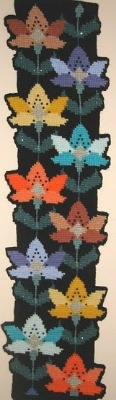
UC: How did you start teaching Tunisian crochet?
Julia: I have always loved to teach, and started at my local Knitters’ Guild, and branched out from there. The largest class I have ever taught is to 30 people.
UC: What do you find most rewarding about teaching Tunisian crochet?
Julia: Students are able to produce a nice even fabric quite quickly. I always provide a small project that can be finished in class, and as the piece progresses I introduce colour inlay and bobbles. I have taught it to crocheters, knitters and to some students who have had no experience in either.
UC: Where do you generally find your creative inspiration?
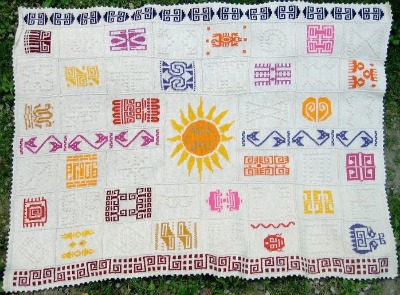
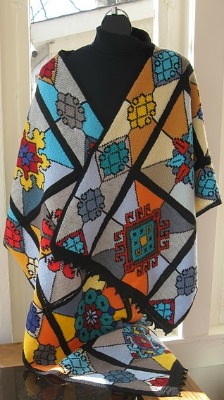
Julia: In the world around me. I have travelled extensively in Morocco, where I am surrounded by incredible colours and designs everywhere I look, and I have incorporated many of their tile designs into my work. Art galleries, museums and books also feed my creative muse. (UC comment: I’d like to mention that when I visited Toronto in 2006, I was extremely impressed with the collection at the Textile Museum and the city’s overall friendliness towards the fiber arts. I’m sure living in such an environment can also “feed the creative muse.”)
UC: What is your favorite crochet book in your collection (besides yours, of course)?
Julia: I do not have a favourite crochet book. Books of designs from all parts of the world are my standbys.
UC: You seem to be multi-craftual. What’s your favorite “go to” craft when working on personal projects?
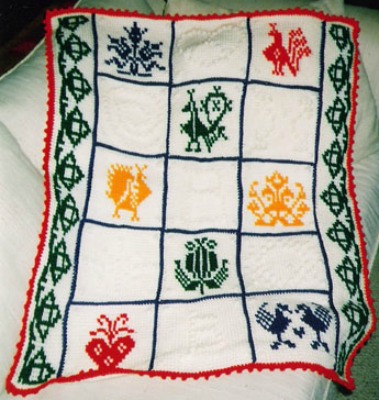
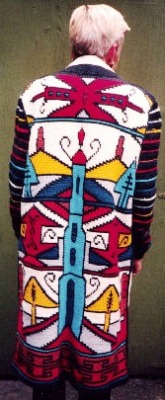
Julia: My projects vary according to the space I am in. Simple knitting while waiting in the doctor’s office, elaborate Tunisian crochet projects sitting on the dock at the cottage, something less challenging after a tiring day. My four grandchildren inspired to make each of them a Tunisian crochet blanket and a cross-stitch sampler.
UC: Do you have anything else you’d like to add?
Julia: I feel blessed to have the skills I have, and to be able to share them with others. I have met many wonderful people through knitters’ guilds and conferences. Knitting or crocheting on trains, planes and buses will often lead to conversations. Seeing the joy in someone’s eyes when they finally “get it”. Welcome to the world of craft and creativity!
Thanks again, Julia, for stopping by for an interview and sharing your amazing work!
Julia’s work is so amazing it brings tears to my eyes. I am so glad I got to read about her and see her work – so inspiring!
It really is stunning, Patricia! Thanks for stopping by.
Your projects are fantastic! We have been admiring them and they are overwhelming. I wish I could one day visit you and see this wonderful work. I have just learnt crocheting and knitting and I am inspired by your designs but I don’t think am there yet.
That gift you have is a blessing indeed.
Rose, thanks for visiting. Julia’s work is truly incredible.